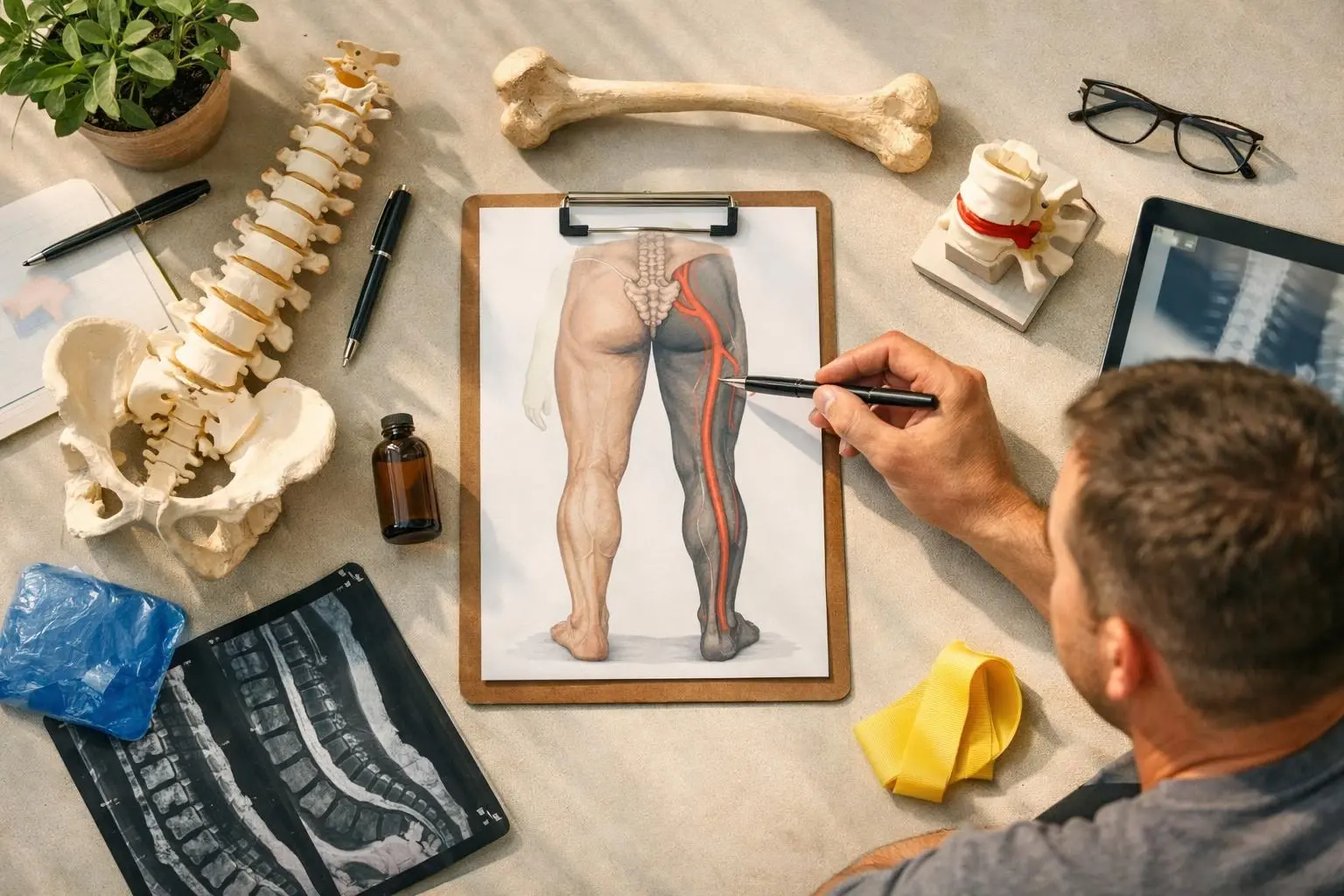
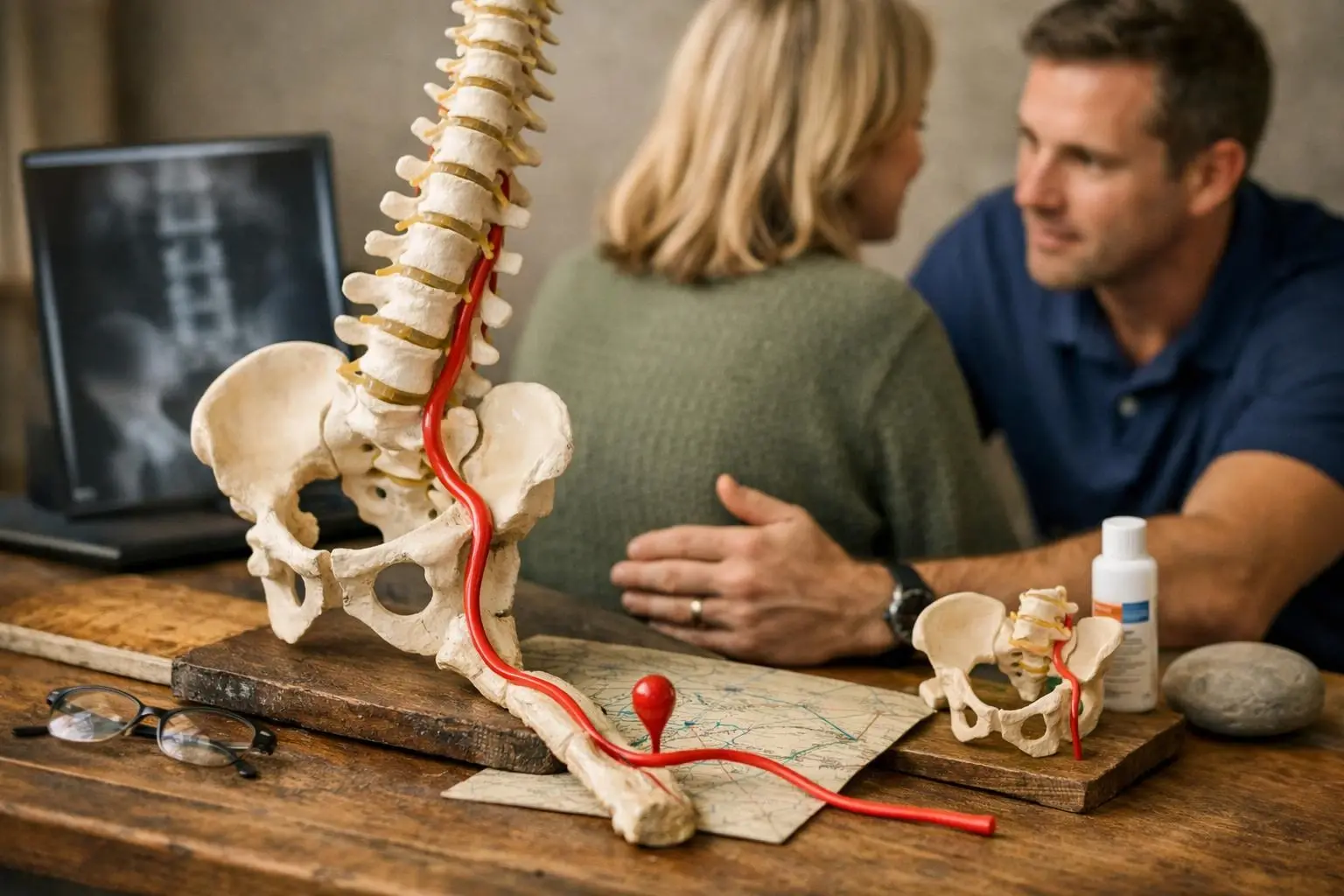
Sciatica is pain that radiates along the path of the sciatic nerve, which runs from the lower back through the hips and buttocks and down each leg. Sciatica typically affects only one side of the body and occurs when the nerve is compressed or irritated, often due to a herniated disc, bone spur. Or spinal stenosis.
Category
Nerve-related pain condition
Used for
Diagnosing and treating lower back and leg pain
Common confusion
Often mistaken for general back pain or muscle strain
Also called
Sciatic nerve pain, Sciatic neuritis
Often discussed with
Chiropractic Consultation and Diagnosis, Work Injury Treatment

Sciatica causes pain along the sciatic nerve. This nerve is the longest and thickest in the body.
Related glossary terms: Nerve Compression, Disc Herniation, Spinal Stenosis.
It starts in the lower back. It splits into branches. These go through the buttocks and hips. They go down each leg.
Sciatica happens when something presses or bothers the nerve. This can be a herniated disc (a bulging disc). It can be a bone spur (a bony bump). It can be spinal stenosis (a narrow spine).
The pain can be mild or very bad. It may feel sharp or like a burn. It may feel like an electric shock.
Sciatica is often linked to back pain. But sciatica pain moves downward. It follows the nerve path.
Pain may start in the lower back. It can go to the thigh, calf. Or foot. Some people feel numb or tingly. Some feel weak in the leg.
Sciatica is not a diagnosis. It is a sign of another problem. This could be a herniated disc or spine issue.
The sciatic nerve comes from nerve roots. These roots leave the spinal cord in the lower back.
If a root gets pressed or bothered, it sends pain signals. The pain follows the nerve path.
A herniated disc can bulge out. It can press on a nerve root. This causes swelling and pain.
Spinal stenosis is a narrow spinal canal. It can squeeze nerve roots. This leads to sciatic pain.
Sciatica pain can differ. It depends on what bothers the nerve. Some feel a steady ache. Others feel sharp pains now and then.
Sitting too long can make pain worse. Coughing or sneezing can too. Walking or lying down may help a bit.
In bad cases, sciatica can weaken muscles. It can make it hard to move the leg.

Sciatica can hurt daily life. It can make moving hard. It can cause a lot of pain.
Unlike back pain, sciatica often hits one side. It can make walking or standing hard. Sitting can be tough too.
If not treated, sciatica can cause long-term problems. It can damage nerves or weaken muscles. This makes everyday tasks harder.
Early help can stop sciatica from getting worse. It can make life better.
Sciatica can mean there’s a spine problem. This problem may need a doctor’s care.
A herniated disc may not heal on its own. Spinal stenosis won’t either. Ignoring them can cause bigger problems.
Know the signs of sciatica. These are pain that moves, numbness. Or weakness. Getting help early can stop the problem from growing.
Sciatica matters when pain messes with daily life. It can make work hard too.
People who sit a lot may feel worse. So may those who lift heavy things. Those who move the same way over and over may too.
Athletes may feel sciatic pain. It can happen when running, bending. Or twisting.
Older adults may get sciatica more. Their spines change with age. Discs wear down. Bone spurs can grow. These press on nerves.
Some sciatica signs are very serious. Weak muscles are one. Losing bladder or bowel control is another. Numbness in the groin is too.
These signs mean a rare but bad problem. It’s called cauda equina syndrome. It needs a doctor right away.
Most sciatica can be helped. Chiropractic care can help. So can physical therapy. Changing daily habits can ease nerve pressure too.
A pinched nerve refers to any nerve compressed by surrounding tissue. While sciatica specifically involves the sciatic nerve and often causes leg pain.
Lower back pain is localized to the back, whereas sciatica pain radiates down the leg due to nerve irritation.
A herniated disc is a common cause of sciatica. But not all herniated discs lead to sciatic pain.
Sciatica is often misdiagnosed as a muscle strain or general back pain. A thorough examination, including neurological tests and imaging, can help pinpoint nerve involvement and guide effective treatment.
A construction worker notices sharp pain starting in his lower back that shoots down his right leg whenever he bends to lift heavy materials. The pain worsens after long hours of standing but improves when he lies down. His doctor confirms sciatica caused by a herniated disc pressing on a nerve root.
Nerve compression is a condition where surrounding tissues such as bones, muscles. Or tendons press on a nerve, causing pain, tingling, numbness. Or weakness. Nerve compression commonly occurs in the spine, wrists. Or elbows and can result from injury, repetitive motion.
Disc herniation is a spinal condition where the soft inner gel of a spinal disc leaks through a tear in its tough outer layer. This leakage can press on nearby nerves, causing pain, numbness. Or weakness in the back, arms. Or legs. Disc herniation often occurs in the lower back or neck due to injury, aging.
Spinal Stenosis is a narrowing of spaces within the spine that puts pressure on the nerves traveling through it. This condition most commonly occurs in the lower back and neck, often causing pain, numbness. Or weakness in the legs, arms. Or torso. Spinal Stenosis typically develops slowly over time due to aging, arthritis. Or injury. And it can limit daily activities if left untreated.
Low Back Pain is discomfort or pain located in the lower part of the spine, between the bottom of the rib cage and the top of the legs. Low Back Pain can range from mild to severe and may limit movement, affect daily activities. Or signal an underlying condition like muscle strain, disc injury. Or arthritis. It is one of the most common reasons people visit healthcare providers.
Pinched Nerve is a condition where too much pressure is applied to a nerve by surrounding tissues, such as bones, cartilage, muscles. Or tendons. This pressure disrupts the nerve’s function, causing pain, tingling, numbness. Or weakness. Pinched Nerve often occurs in areas like the neck, back. Or wrists and can result from injury, poor posture.
Arrowhead Clinic Chiropractor
Contact Arrowhead Clinic Chiropractor for practical guidance on Sciatica and related chiropractor work in Newnan.