
What Is a Pinched Nerve?
Pinched Nerve is a condition in which pressure or irritation affects a nerve near the spine or another body structure. The pressure may change how nerve signals travel, causing pain, tingling, numbness, or weakness along the nerve’s path. The underlying source can involve nearby joints, discs, muscles, or other tissues.
Quick Facts About Pinched Nerve
Category
Nerve irritation or compression
Used for
Describing nerve-related pain and altered sensation
Common confusion
Often confused with muscle strain
Also called
Compressed nerve, Nerve compression
Often discussed with
Neck Pain Treatment
Key Takeaways About Pinched Nerve
- Nerve pressure may produce symptoms beyond the irritated area.
- The source can involve joints, discs, muscles, or nearby tissues.
- A pinched nerve is not the same as ordinary muscle soreness.
How Pinched Nerve Works
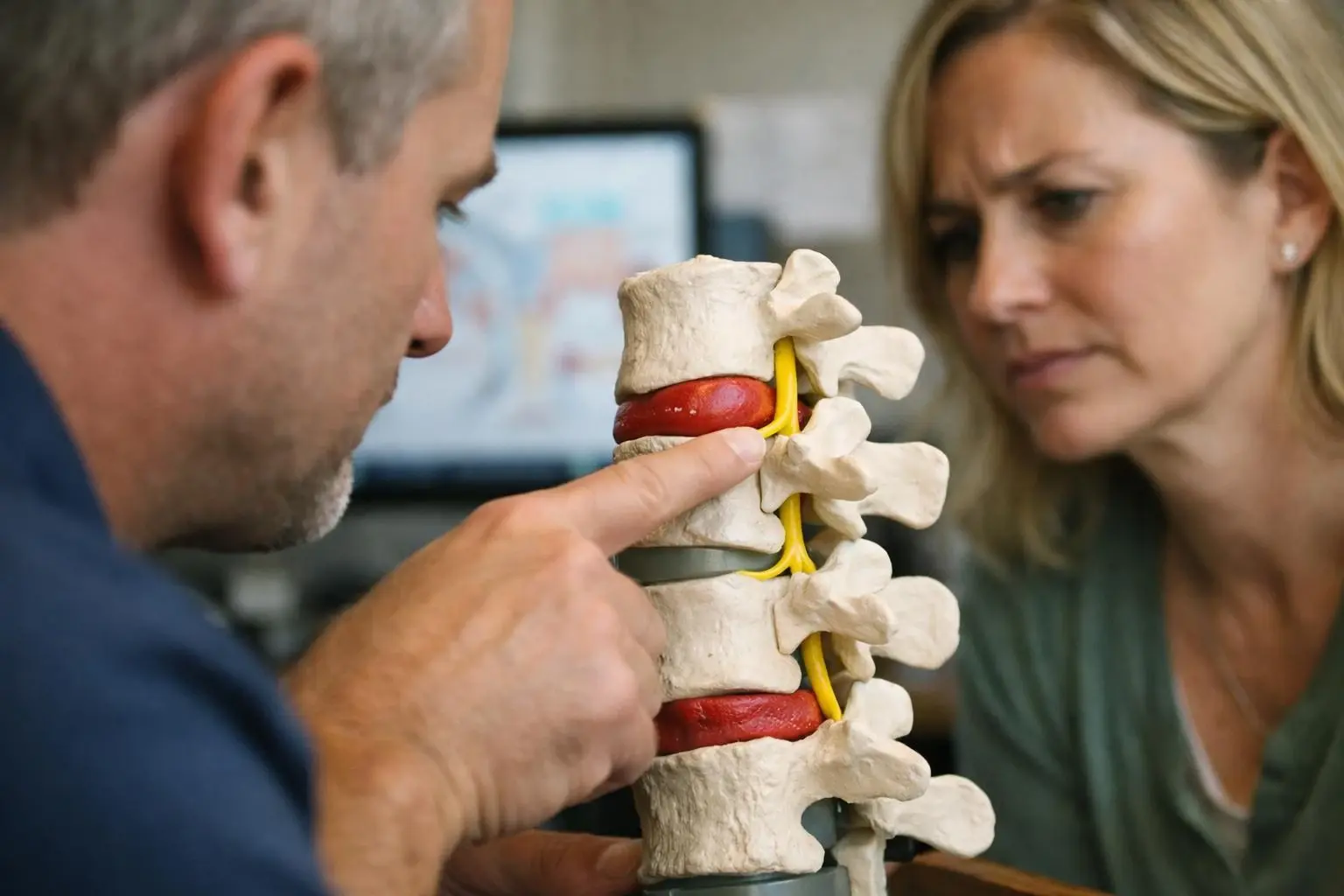
Pinched Nerve describes a change in nerve function caused by pressure or irritation near the nerve. The nerve may send altered signals along its route, which can create pain, tingling, numbness, or weakness. Symptoms may appear near the source or farther along the affected nerve.
Related glossary terms: Cervical Spine, Bulging Disc, Disc Herniation.
In neck-related cases, the Cervical Spine can be involved because nerves leaving the neck travel toward the shoulder, arm, and hand. A disc, joint, muscle, or change in surrounding tissue may affect the available space. Symptoms that travel away from the neck can resemble Referred Pain, so an evaluation considers the symptom pattern, movement, strength, and sensation together.

From the Arrowhead Clinic Chiropractor Newnan team
When we assess a possible pinched nerve, we review symptom location, movement, strength, and sensation together. We also consider whether neck joints, discs, muscles, or nearby tissues may contribute to the pattern. Our team uses that information to guide care within the Neck Pain Treatment service.
Pinched Nerve in Practice: A Real-World Example
A person with neck pain may also feel tingling that travels into the shoulder and hand. That pattern can suggest irritation along a nerve pathway, so the evaluation considers the neck and the affected arm together.
Related Services
Related Terms
Cervical Spine
The cervical spine is the neck section of the spinal column that supports the head and…
Bulging Disc
A bulging disc is a spinal disc that extends beyond its usual boundary while the outer…
Disc Herniation
Disc Herniation is a condition in which the soft inner material of an intervertebral disc pushes…
Referred Pain
Referred Pain is discomfort felt in an area that differs from the tissue or structure generating…
Arrowhead Clinic Chiropractor Newnan
Have Questions About Pinched Nerve?
Contact Arrowhead Clinic Chiropractor Newnan for practical guidance on Pinched Nerve and related chiropractor work in Newnan.