What Is Torticollis?
Torticollis is a condition in which the neck muscles cause the head to tilt or turn away from a neutral position. The condition may appear at birth or develop later after muscle irritation, injury, illness, or changes in movement. Symptoms can include limited neck motion, uneven shoulder position, and neck discomfort.
Quick Facts About Torticollis
Category
Neck movement condition
Used for
Describing head tilt or rotation
Common confusion
Often confused with cervical spine curvature
Also called
Wry neck, Cervical dystonia
Often discussed with
Pediatric Chiropractic Care
Key Takeaways About Torticollis
- A tilted or rotated head distinguishes torticollis from ordinary neck stiffness.
- Assessment considers head position, muscle balance, and neck movement.
- Torticollis is not the same as a spinal curve disorder.
How Torticollis Works
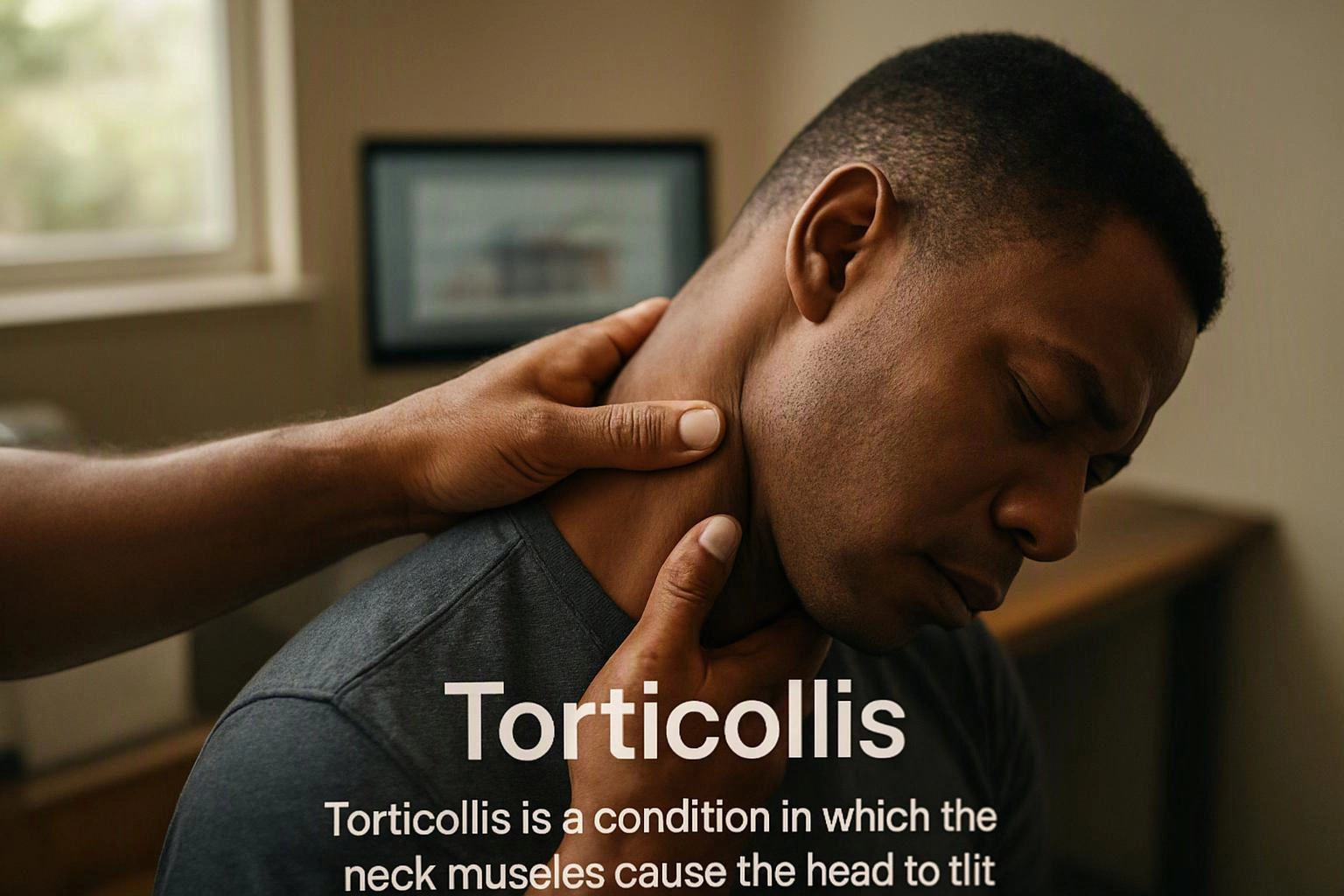
Torticollis affects head and neck alignment when muscles on one side pull more strongly, remain shortened, or do not coordinate evenly. That imbalance can turn the face, tilt the head, or limit comfortable movement. A clinician observes resting posture and compares movement toward each direction.
Related glossary terms: Cervical Spine, Joint Mobility, Range Of Motion.
Assessment also considers the cervical spine, shoulder position, muscle tone, and range of motion. In infants, positioning during rest and feeding may offer useful clues. In older children, the condition may follow strain, inflammation, or a change in movement habits. The term describes a movement pattern, so evaluation also considers the person’s age, history, and related symptoms.

From the Arrowhead Clinic Chiropractor Newnan team
When we assess torticollis in pediatric chiropractic care, we observe head position, neck movement, shoulder balance, and muscle tension. We also review the child’s history and watch how movement changes during natural activities. Our findings help us distinguish a movement pattern that may need broader medical evaluation from one related to musculoskeletal function.
Torticollis in Practice: A Real-World Example
A child may consistently turn the head toward one side during tummy time and feeding. Pediatric chiropractic care may examine the child’s neck movement, resting posture, and muscle balance as part of the evaluation.
Related Services
Related Terms
Cervical Spine
The cervical spine is the neck section of the spinal column that supports the head and…
Joint Mobility
Joint Mobility is the capacity of a joint to move freely through its available range while…
Range Of Motion
Range Of Motion is the available movement at a joint or body region, measured by how…
Muscle Spasm
Muscle Spasm is an involuntary tightening of muscle tissue that can restrict movement and create localized…
Arrowhead Clinic Chiropractor Newnan
Have Questions About Torticollis?
Contact Arrowhead Clinic Chiropractor Newnan for practical guidance on Torticollis and related chiropractor work in Newnan.