
What Is Joint Mobility?
Joint Mobility is the capacity of a joint to move freely through its available range while nearby tissues support controlled motion. The term describes movement quality, not simply flexibility. A joint may have adequate flexibility yet lack control, coordination, or smooth movement during tasks such as walking, reaching, lifting, or bending.
Quick Facts About Joint Mobility
Category
Movement capacity
Used for
Controlled joint movement
Common confusion
Flexibility and mobility are not identical
Also called
Joint range of motion
Often discussed with
Corrective Exercise Therapy
Key Takeaways About Joint Mobility
- Mobility combines available movement with control.
- Exercise can address movement limits during daily tasks.
- Mobility is not the same as flexibility.
How Joint Mobility Works
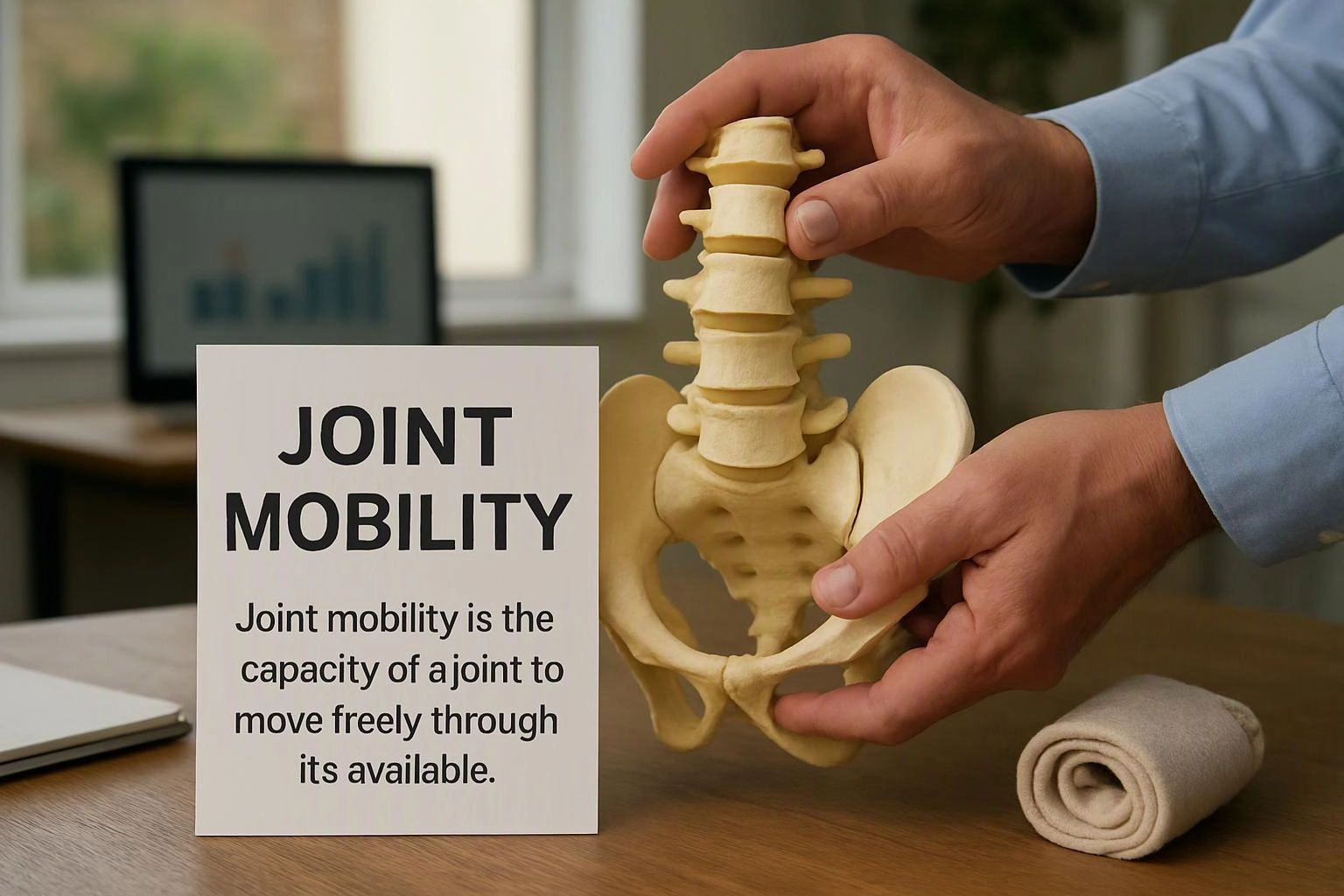
Joint mobility depends on the shape of a joint, the surrounding muscles and connective tissues, and the nervous system's ability to coordinate movement. These factors work together as a person bends, rotates, reaches, or bears weight. Limited motion may appear as stiffness, an altered movement pattern, or difficulty completing a task smoothly.
Related glossary terms: Range Of Motion, Biomechanics, Facet Joint.
Assessment often compares movement from side to side and observes control through a comfortable range. Range of motion describes how far a joint moves. Mobility also considers how the body manages that movement, so an exercise may focus on active control, breathing, posture, or gradual loading. Corrective Exercise Therapy may pair mobility drills with strength and coordination work when a task exposes a movement limitation.
From the Arrowhead Clinic Chiropractor Newnan team
When we address Joint Mobility, we observe how a person moves during a relevant task and check whether the joint moves with control. We then select Corrective Exercise Therapy activities that match the observed limitation. Our team also considers nearby body regions because one restricted area can change how another joint moves.
Joint Mobility in Practice: A Real-World Example
A person may have difficulty reaching overhead because the shoulder and upper back do not move together smoothly. Corrective Exercise Therapy may use controlled shoulder motion and upper-back exercises to improve the movement pattern during that task.
Related Services
Related Terms
Range Of Motion
Range Of Motion is the available movement at a joint or body region, measured by how…
Biomechanics
Biomechanics is the study of how forces affect human movement and how body structures respond during…
Facet Joint
A facet joint is a small paired joint at the back of the spine that connects…
Sacroiliac Joint
A sacroiliac joint is the connection between the sacrum at the base of the spine and…
Arrowhead Clinic Chiropractor Newnan
Have Questions About Joint Mobility?
Contact Arrowhead Clinic Chiropractor Newnan for practical guidance on Joint Mobility and related chiropractor work in Newnan.